Hong Kong AI Chat App "HKChat": Supports Trilingual Inquiries for Traffic, Weather, and Legal Advice

In this issue
|
Hands-on with 'HKChat' AI App: Trilingual Support for Traffic, Weather, and Legal Inquiries

The local AI chat application 'HKChat' has launched its trial version, integrating large language model technology from the Hong Kong Centre for Generative AI (HKGAI). Designed specifically for Hong Kong residents, it provides information on traffic, weather, daily life, and legal consultations. The app supports mixed input in Cantonese, English, and Mandarin, aiming to address the localization issues often found in foreign AI models by delivering grounded, practical responses.
- Localized AI Service: Built with HKGAI technology and integrated with government public data, 'HKChat' understands and responds in local dialect (including mixed code-switching Cantonese), improving upon the limitations of foreign AI models.
- Practical Features and Performance: The app performs well in providing traffic (e.g., bus routes, arrival times) and lifestyle information, though it may still exhibit 'AI hallucinations' when handling complex political or current affairs questions, indicating room for optimization.
- Future Vision: The development team envisions 'HKChat' as a daily assistant for Hong Kong people and plans to expand the use of generative AI in public services, complementing internal government applications like 'HKWritingHub' (港文通).
Industrial News
SMEs apply AI at low cost with one click! Ricoh and HGC join hands to launch AI2B ecosystem

Ricoh Hong Kong and Hutchison Telecommunications Hong Kong (HGC) have signed a memorandum of understanding to jointly promote the 'AI2B ecosystem,' aiming to help Hong Kong SMEs achieve digital transformation at a low cost. The partnership focuses on the education, retail, and hospitality sectors, integrating Ricoh's AI technology with HGC's 5G network and customer base to provide practical AI solutions that address resource and technical gaps.
- Strategic AI2B Partnership: Ricoh and HGC have collaborated to act as 'enablers' for enterprise transformation, leveraging their respective strengths in innovative technology and business networks, reaching an agreement in just three months.
- New AI Document Processor: Ricoh launched a new 'AI Document Processor' featuring InnoAI Linker technology, allowing one-click connection to Large Language Models (LLMs) to instantly convert paper documents into actionable data insights.
- Targeting Three Key Industries: The initiative specifically addresses pain points in education (freeing up teachers' time), retail (optimizing resources and customer experience), and hospitality (enhancing service quality and information transparency) with practical AI applications.
Saving 500 Hours Monthly with 'Offline AI' & Enhancing Service via Data Insights

MindLayer.io presents an AI solution tailored for Hong Kong public services, citing a local airline case study where voice technology replaced manual entry to save 500 worker hours monthly. The solution features 'On-Device AI' for strict data privacy, localized speech recognition for mixed Cantonese/English, and a 'Heads-Up' interface that allows staff to maintain eye contact with citizens.
- Efficiency & User Experience: By saving 20 seconds per interaction, the system frees up 500 hours monthly and enables a 'Heads-Up' service experience, removing the 'screen wall' so staff can focus on personal connection.
- Strategic Data Insights: The system transforms interactions into actionable data, offering hotspot analysis for FAQ optimization, sentiment analysis for satisfaction tracking, and 'Red Flag' detection for early risk warning.
- Localized & Secure Tech: Addressed specific Hong Kong challenges by fine-tuning for Cantonese-English code-mixing and utilizing 'On-Device AI' to process data locally without internet, ensuring zero latency and high data privacy.
Research & Development
China's DeepSeek challenges Google DeepMind and OpenAI with new AI model

Chinese AI start-up DeepSeek has unveiled its latest artificial intelligence model, DeepSeek-V3.2-Speciale, claiming it rivals the reasoning capabilities of Google's Gemini 3 Pro and OpenAI's leading models. Despite facing US export controls on advanced semiconductors, DeepSeek achieved this breakthrough using older chips (Nvidia H800s) and a highly efficient architecture. The release has sparked significant debate in the tech world, challenging the dominance of US tech giants and proving that cutting-edge AI can be built at a fraction of the cost previously thought necessary.
- Performance Rivals Top US Models: DeepSeek claims its new V3.2-Speciale model matches the reasoning abilities of Google DeepMind's Gemini 3 Pro and performs on par with OpenAI's most advanced systems in complex tasks like mathematics and coding.
- Breakthrough in Efficiency: The model was trained using a relatively small cluster of restricted Nvidia H800 chips and at a significantly lower cost (millions rather than billions of dollars) compared to its US competitors, challenging the industry's reliance on massive compute power.
- Geopolitical and Market Impact: DeepSeek's success demonstrates China's resilience against US tech sanctions and has disrupted the market, causing fluctuations in tech stocks like Nvidia as investors reassess the capital intensity required for future AI development.
Tencent releases Hunyuan 2.0, its next-generation AI model

Tencent has unveiled Hunyuan 2.0, its latest self-developed AI model available in 'Think' and 'Instruct' versions. Built on a Mixture-of-Experts (MoE) architecture with 406 billion parameters, it supports a 256K context window and delivers enhanced performance in complex reasoning tasks like math, science, and coding.
- Advanced Architecture: The model utilizes a Mixture-of-Experts (MoE) architecture featuring 406 billion total parameters with 32 billion active parameters, supporting an ultra-long 256K context window.
- Enhanced Reasoning: Hunyuan 2.0 Think boasts major improvements in pretraining data and reinforcement learning, excelling in complex reasoning across mathematics, science, and coding.
- Integration and Availability: Hunyuan 2.0 is already integrated into Tencent's AI-native products like Yuanbao and ima, and is accessible to users via Tencent Cloud's APIs.
Tools
Google Launches "Workspace Studio": Create Gemini 3-Powered AI Agent Teams via Prompts Without Coding
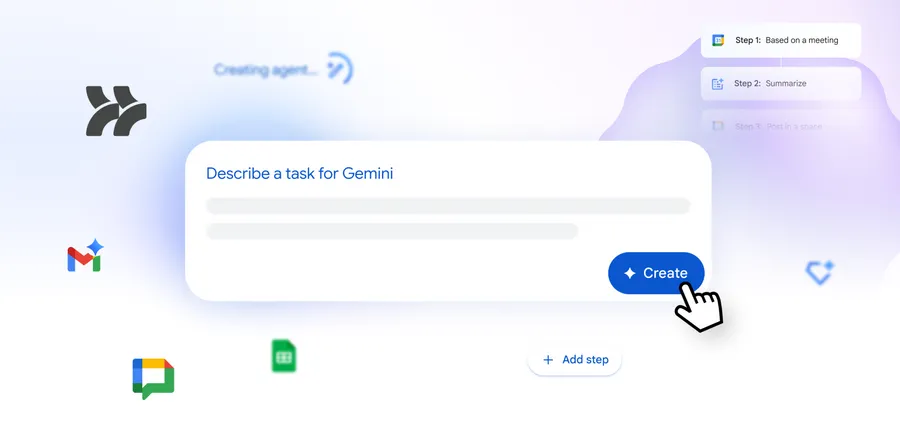
Google has officially launched Workspace Studio, enabling users to design and manage Gemini 3-powered AI agents using simple natural language prompts. This platform lowers the barrier to automation by offering deep integration across Workspace apps like Gmail, Drive, and Chat, while also supporting connections to enterprise systems like Asana and Salesforce to build efficient virtual teams.
- Zero Coding Required: Users without technical backgrounds can build context-aware AI agents with reasoning capabilities in minutes simply by describing their needs in natural language.
- Deep Workspace Integration: AI agents are natively integrated into Gmail, Drive, and Chat, capable of handling daily tasks such as email prioritization, data extraction, and cross-app collaboration.
- Enterprise-Grade Scalability: The platform supports third-party integrations with apps like Asana and Jira, and offers Apps Script for custom steps to handle complex, end-to-end enterprise workflows.
Trending
Tai Po Wang Fuk Court Fire: Programmer uses AI to build safety check website in 30 minutes

Following a severe 5-alarm fire at Wang Fuk Court in Tai Po that left hundreds missing, a 30-year-old programmer named Nathan used AI to build a 'Safety Reporting Web App' in just 30 minutes. The tool was created to consolidate missing person information after community-created Google Sheets crashed due to high traffic.
- Rapid AI Response: Leveraging AI for coding, the developer launched a functional and stable safety check website in half an hour to replace overloaded community spreadsheets.
- Adaptive Management: Faced with vandalism of the initial open-access data, the system was quickly modified to a verified submission process managed by a team of volunteers.
- Tech for Social Good: Despite incurring hosting costs from high traffic, the programmer focused on using his skills to aid the community and is seeking a fee waiver from Google.